7 signs your portfolio isn't actually diversified
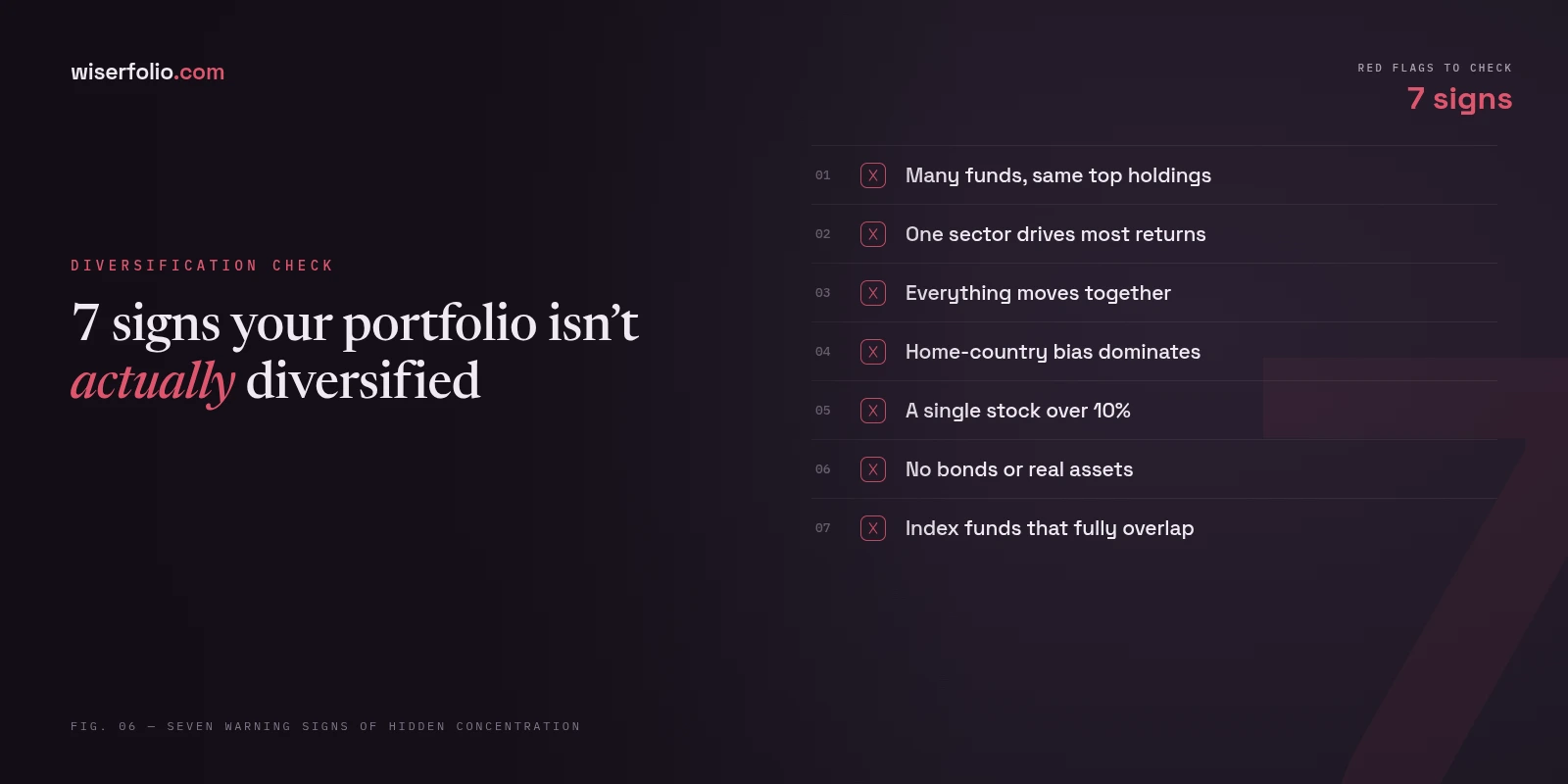
Ask most investors if their portfolio is diversified and they'll say yes — they own ten funds, across different AMCs, in different categories. But "owning a lot of things" and "being diversified" are not the same, and the gap between them is where most portfolios quietly carry far more risk than their owners realise. Here are the warning signs that your diversification might be an illusion.
True diversification means owning things that behave differently — when one falls, another holds steady or rises. A portfolio that looks varied on the surface but moves as a single block when markets turn is not diversified; it just feels that way until a downturn proves otherwise. These are the signs to check for.
Sign 1: One stock is more than 20% of your portfolio
If a single stock makes up more than a fifth of your holdings, your portfolio's fate is tied to that one company. It might be an ESOP allotment, an inheritance, or a winner that grew until it dominated. Whatever the cause, the math is unforgiving: if a stock that's 20% of your portfolio falls 50%, your whole portfolio drops 10% from that one position alone. Above 20% is a flag; above 40% means you don't really have a portfolio, you have a concentrated bet. This is the most common and most damaging form of hidden risk — and we cover it in depth in when one stock is half your portfolio.
Sign 2: One sector dominates everything
Even with no single large stock, your portfolio can be concentrated by sector. In India this happens most often with financials — bank and lending stocks dominate the index, feel safe and familiar, and quietly accumulate until 50% or more of a portfolio sits in one sector. The problem: a single interest-rate decision or regulatory change can move your entire net worth at once. If more than 40% of your holdings cluster in one sector, your "diversified" portfolio has a single point of failure.
The tell: if a 2020-style crash, or one bad day for one industry, would take down most of your portfolio together — you're not diversified, no matter how many holdings you have.
Sign 3: Your mutual funds hold the same stocks
This is the sneakiest one, because it's invisible on a statement. You own five equity funds and feel diversified — but if they're all large-cap or flexi-cap funds, they almost certainly hold the same top stocks: the same HDFC Bank, Reliance, Infosys, at different weights under different names. You're paying five expense ratios for what is effectively one bet. Two funds in the same category sharing more than 60% of their holdings is a clear sign one of them isn't earning its place. This "fund overlap" is common enough that we wrote a full guide on why owning five funds isn't diversification and a practical walkthrough of how to check your mutual fund overlap.
Sign 4: All your funds follow the same style
A subtler version of overlap. Even funds in different categories can share an investment style — value, momentum, or quality. If most of your funds lean the same way (say, all momentum-tilted because momentum has done well recently), they'll outperform together in good times and underperform together when that style falls out of favour. You diversified across categories and AMCs but accidentally concentrated on a single style. It's hard to spot without looking under the hood of each fund, which is exactly why it catches so many careful investors.
Sign 5: Everything you own is Indian equity
If 100% of your portfolio is Indian stocks and equity funds, you're exposed to a single country's economic cycle. Indian equity is a strong long-term asset, but a portfolio with no debt, no gold, and no international exposure has no shock absorber when domestic equity has a bad year. Real diversification spans asset classes that behave differently — equity, debt, gold, and ideally some global exposure — not just many flavours of the same asset.
Sign 6: You haven't reviewed it in over a year
Portfolios drift. A strong equity run can quietly push your allocation from a planned 60% equity to 75% without you doing anything — meaning you're now carrying more risk than you chose to. If you haven't looked at your structure (not just the returns, the structure) in 12 months or more, there's a good chance it has drifted away from what you intended. Strong markets are exactly when this happens, because everything's going up and nothing feels wrong.
Sign 7: You couldn't actually explain why you own each holding
This is the human one, and often the most telling. If you scroll through your holdings and find funds you added on a tip, an NFO a relationship manager called "a unique opportunity," an ELSS you started for tax and forgot — and you can't say what distinct job each one does — then your portfolio wasn't designed, it accumulated. An accumulated portfolio is almost always more overlapping and less diversified than one built on purpose, because nothing was ever chosen to complement what you already had.
How to actually check
You can work through these signs by hand: add up your largest holding's weight, group everything by sector, pull each fund's factsheet and compare holdings, check your equity-debt split. It's genuinely worth doing, and our guide on how to read your portfolio like an analyst walks through the full process.
The catch is that some of these — fund overlap, style concentration, true sector exposure across both your stocks and funds — are tedious or nearly impossible to eyeball accurately. That's the gap our portfolio analyzer was built to close: you upload the statement you already have, and it checks every one of these signs against your actual holdings — your real concentration, your true sector weights, the overlap between your funds — and tells you honestly where your diversification is real and where it's an illusion. No login, first report free.
The bottom line
Diversification isn't about how many holdings you have — it's about whether they behave differently when it matters. A portfolio of twenty holdings that all move together is more fragile than five that genuinely don't. If several of these warning signs feel familiar, it's worth checking properly, because the time to discover your diversification was an illusion is before a downturn reveals it, not after.
Find out if your portfolio is actually diversified
Upload your statement and Wiserfolio checks your real concentration, fund overlap, and sector risk in 90 seconds — and tells you honestly where the gaps are.
Check my portfolio free →