Why owning 5 mutual funds isn't diversification
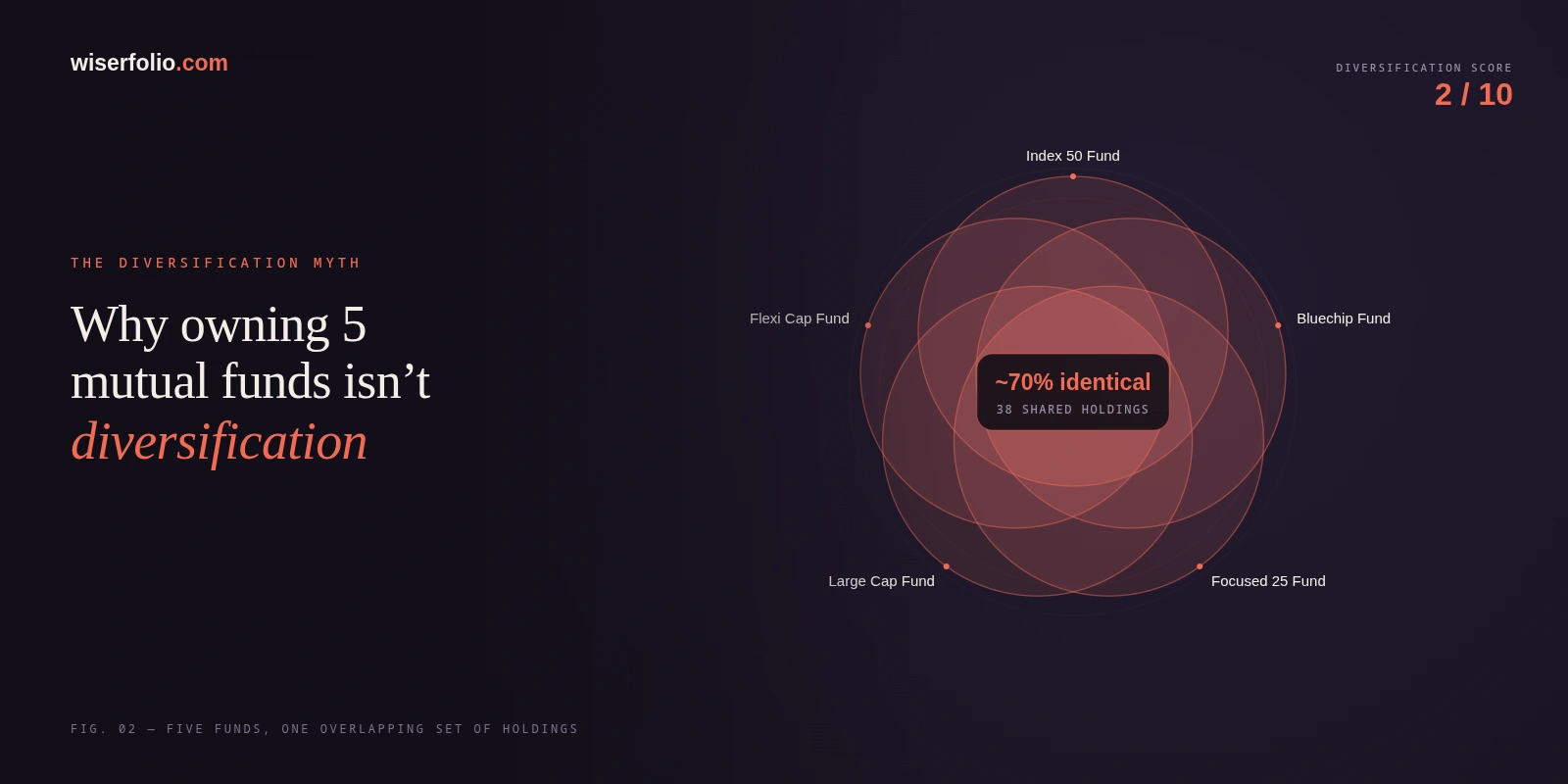
You own five mutual funds because someone told you diversification is good. But what if all five hold HDFC Bank, Reliance, and Infosys as their top positions? You're not diversified — you just own the same companies five times, with five sets of fees.
This is one of the most common and least visible problems in an Indian retail portfolio: fund overlap. It hides behind the comforting feeling of owning "many funds," and it quietly undoes the diversification you thought you were buying.
What fund overlap actually means
Every equity mutual fund holds a basket of stocks. Two funds "overlap" when they hold many of the same stocks. A large-cap fund and a flexi-cap fund in India will both, almost inevitably, hold large positions in the same handful of giants — because those giants dominate the index every fund is measured against.
So when you buy a second, third, or fourth fund hoping to spread your risk, you often end up concentrating it instead. The top 10 holdings of three "different" funds can be 60–80% identical.
The quiet cost: overlapping funds mean you pay multiple expense ratios to own essentially one portfolio — and when those shared stocks fall, all your "diversified" funds fall together.
Why it happens so easily
- Index gravity. Most active funds are benchmarked to the Nifty or Sensex, so they cluster around the same large-cap names to avoid straying too far from the index.
- Buying by past returns. Investors pick last year's top performers, which were often top because they held the same winning stocks — so you buy the same exposure twice.
- "More funds feels safer." It feels diversified to own many funds. The feeling and the reality diverge sharply.
How to check your own overlap
The manual way: pull the latest factsheet for each fund, list the top 10–15 holdings, and compare them side by side. Where the same stocks appear across funds, sum up how much of your total portfolio sits in each. It's tedious but revealing.
The faster way is to let software read your statement and do the cross-fund comparison for you — which is exactly what a portfolio analysis tool is built for. It can flag, for instance, that "62% of Fund A and Fund B are the same 12 stocks," something almost impossible to eyeball.
What to do once you find overlap
- Don't panic-sell. Overlap isn't an emergency; it's an inefficiency. Fix it deliberately, mindful of exit loads and capital-gains tax.
- Consolidate. If two funds are 70% identical, you likely don't need both. Keeping the better one (lower cost, more consistent) and redirecting future SIPs there simplifies your portfolio and cuts fees.
- Diversify by mandate, not by count. True diversification comes from owning genuinely different things — large-cap, mid/small-cap, international, debt — not from owning more funds in the same category.
- Mind the tax. Switching funds is a sale. Use your annual LTCG exemption and avoid short-term gains where you can.
The goal isn't to own fewer funds for its own sake — it's to make sure every fund you own is actually pulling in a different direction. Overlap is the gap between how diversified you feel and how diversified you are.
Overlap is really hidden concentration — closely related to when one stock dominates your portfolio. For the full set of checks worth running, see how to read your portfolio like an analyst.
See your own portfolio's hidden risks
Upload your statement and Wiserfolio shows your concentration, fund overlap, fees, and tax moves in 90 seconds.
Analyze my portfolio free →