How to switch from regular to direct mutual funds without a big tax hit
You've done the math and realised your regular-plan mutual funds are quietly costing you — that extra 0.7% to 1% a year in commission compounds into a serious sum over a decade. The obvious fix is to switch to direct plans. But there's a catch that stops most people: switching means selling, and selling can trigger capital gains tax. Here's how to think about that trade-off, and how to switch without an unnecessary tax shock.
First, the thing nobody makes clear enough: switching from a regular plan to the direct version of the same fund is not a simple toggle. Even though it's the same scheme with the same manager and the same portfolio, the system treats it as a redemption of your regular units and a fresh purchase of direct units. That redemption is a sale — and a sale of a fund that has grown is a taxable event. This is the friction that keeps people stuck in expensive regular plans for years.
Why the switch is worth considering anyway
The reason the switch matters is compounding. A regular plan might carry an expense ratio of 1.5% where the direct version of the exact same fund charges 0.6%. That ~0.9% difference doesn't sound like much in a single year. But it's charged every year, on your entire balance, and it compounds against you for as long as you hold the fund. Over 15 to 20 years on a meaningful corpus, the gap between regular and direct can run into lakhs — for literally the same underlying investment. You're paying a recurring toll for a service (the distributor) you may no longer need.
The core trade-off: switching costs you a one-time tax event now, in exchange for permanently lower fees going forward. Whether it's worth it depends on how long you'll keep holding — the longer your remaining horizon, the more the lower fees outweigh the one-time tax.
The two costs to check before you switch
Before switching any fund, two things determine whether it's a clean move or an expensive one:
Exit load. Many funds charge an exit load (often around 1%) if you redeem within a certain period of buying — typically the first year. If your units are still inside that window, switching now means paying that penalty on top of everything else. Units held beyond the exit-load period switch without it.
Capital gains tax. When you redeem, any growth is taxed. For equity funds, gains on units held longer than a year are long-term; gains on units held less than a year are short-term and taxed at a higher rate. So the holding period of your specific units drives the tax bill — which leads directly to the strategies below.
How to switch without a big tax hit
The goal is to move to lower fees while keeping the one-time tax as small as possible. A few approaches investors commonly use:
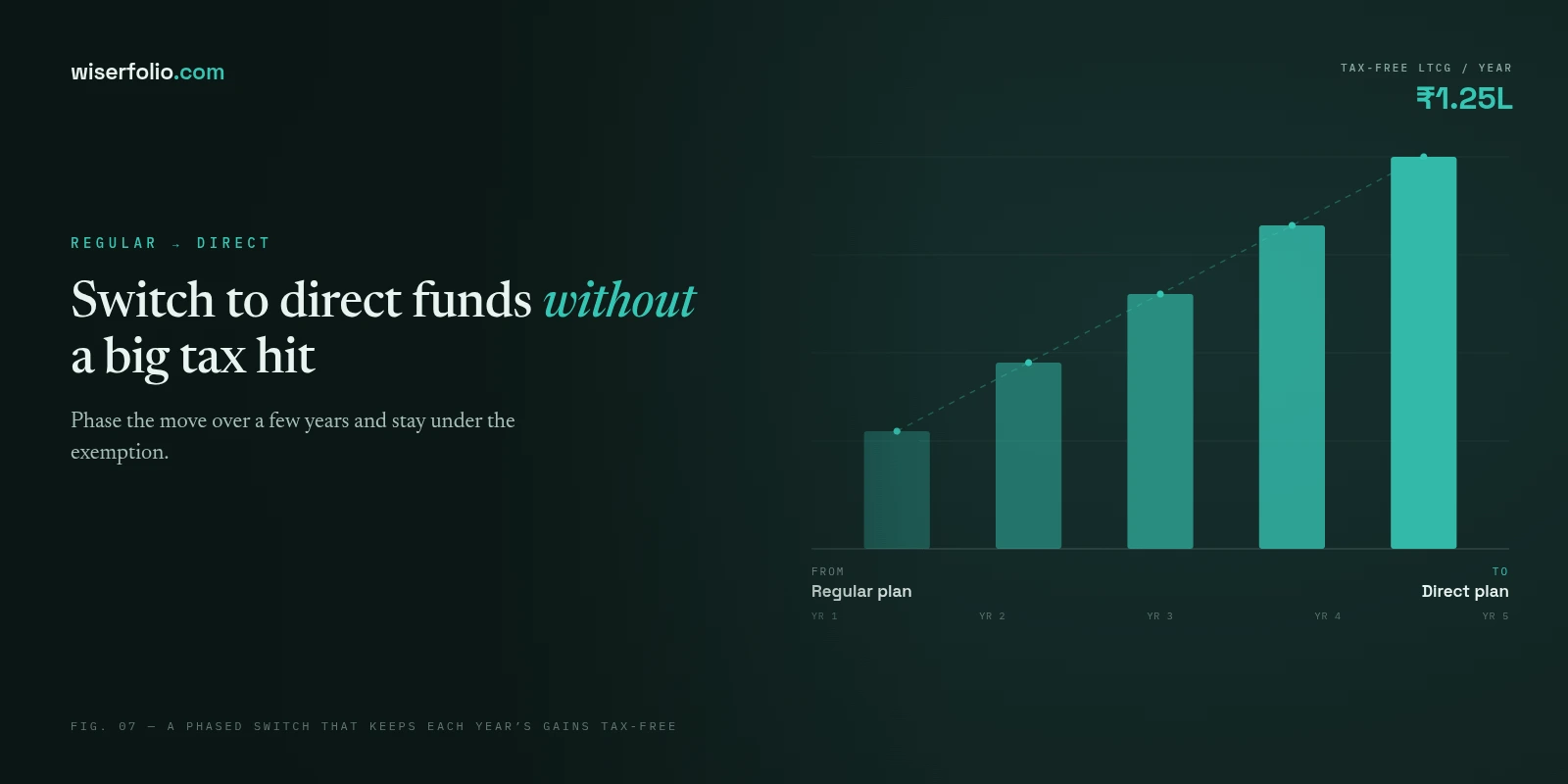
Use the annual long-term exemption. Long-term capital gains on equity funds are tax-free up to ₹1.25 lakh per financial year. If you switch gradually — moving a portion of your holding each year so that the realised long-term gain stays under that limit — you can shift a large position to direct over a few years while paying little or no tax on the way. It takes patience, but it's the cleanest route for a big holding.
Wait out the short-term and exit-load windows. If some of your units are less than a year old, letting them cross the one-year mark before switching converts a higher short-term tax into a lower long-term one — and usually clears any exit-load period at the same time. Switching the older units first and the newer units later is a simple way to sequence this.
Redirect new money immediately. This one has no tax cost at all: stop your SIP into the regular plan and start a fresh SIP into the direct plan today. Every new rupee goes into the low-fee version straight away, while you deal with the existing units on a tax-efficient timeline. Many people forget the switch decision applies to new contributions separately — you don't have to wait to fix those.
Prioritise the worst offenders. Not every fund is worth the switching effort. The ones that matter most are those with the biggest gap between regular and direct expense ratios, and the largest balances — because that's where the recurring saving is biggest. A small holding in a fund with a modest fee gap may not be worth triggering any tax for at all.
When switching might NOT be worth it
Honesty matters here, because switching isn't always the right call. If your units are sitting on a very large unrealised gain and you have a short remaining horizon, the one-time tax could outweigh the fee savings you'd collect in the time left. If you genuinely value and use the advice a distributor provides, the regular plan's cost may be buying you something real. And if a holding is small, the rupee saving from switching may not justify the effort and paperwork. The switch is a tool, not a rule — it's worth it when the future fee savings clearly beat the one-time cost, and not before.
The hard part: knowing which funds to switch
All of this assumes you know which of your funds are regular plans, what their expense ratios are versus the direct equivalents, how large each holding is, and roughly what gains you're sitting on. Most investors don't have that laid out clearly — the information is scattered across statements and factsheets, and regular plans aren't always obviously labelled as such.
This is one of the things our portfolio analyzer surfaces: it reads your holding statement, flags which funds are costing you more in fees, estimates the drag in rupee terms, and highlights the tax angles worth considering before you switch — so you can see, in one place, where the switch is clearly worth it and where it isn't. It doesn't file anything or give you personal tax advice; it shows you the picture so you can make an informed call or take it to your CA.
The bottom line
Switching from regular to direct plans is one of the highest-return moves an investor can make, because the fee saving is permanent and compounds for the rest of your holding period. The tax on switching is real but usually manageable — spread the switch across financial years to use the annual exemption, clear the short-term and exit-load windows first, and redirect all new money to direct immediately. Done thoughtfully, you move to lower fees for good while keeping the one-time tax small. Related reading: how to read your portfolio like an analyst and 7 signs your portfolio isn't actually diversified.
This article is general educational information, not tax or investment advice. Capital gains rules and exit loads vary by fund and change over time — confirm the current specifics and your own tax position with a qualified adviser or chartered accountant before switching.
See exactly how much your funds' fees are costing you
Upload your statement and Wiserfolio flags your regular-plan funds, estimates the fee drag, and highlights the tax angles to consider before switching — in 90 seconds.
Check my portfolio free →