What is Wiserfolio, and how does it differ from other portfolio tools?
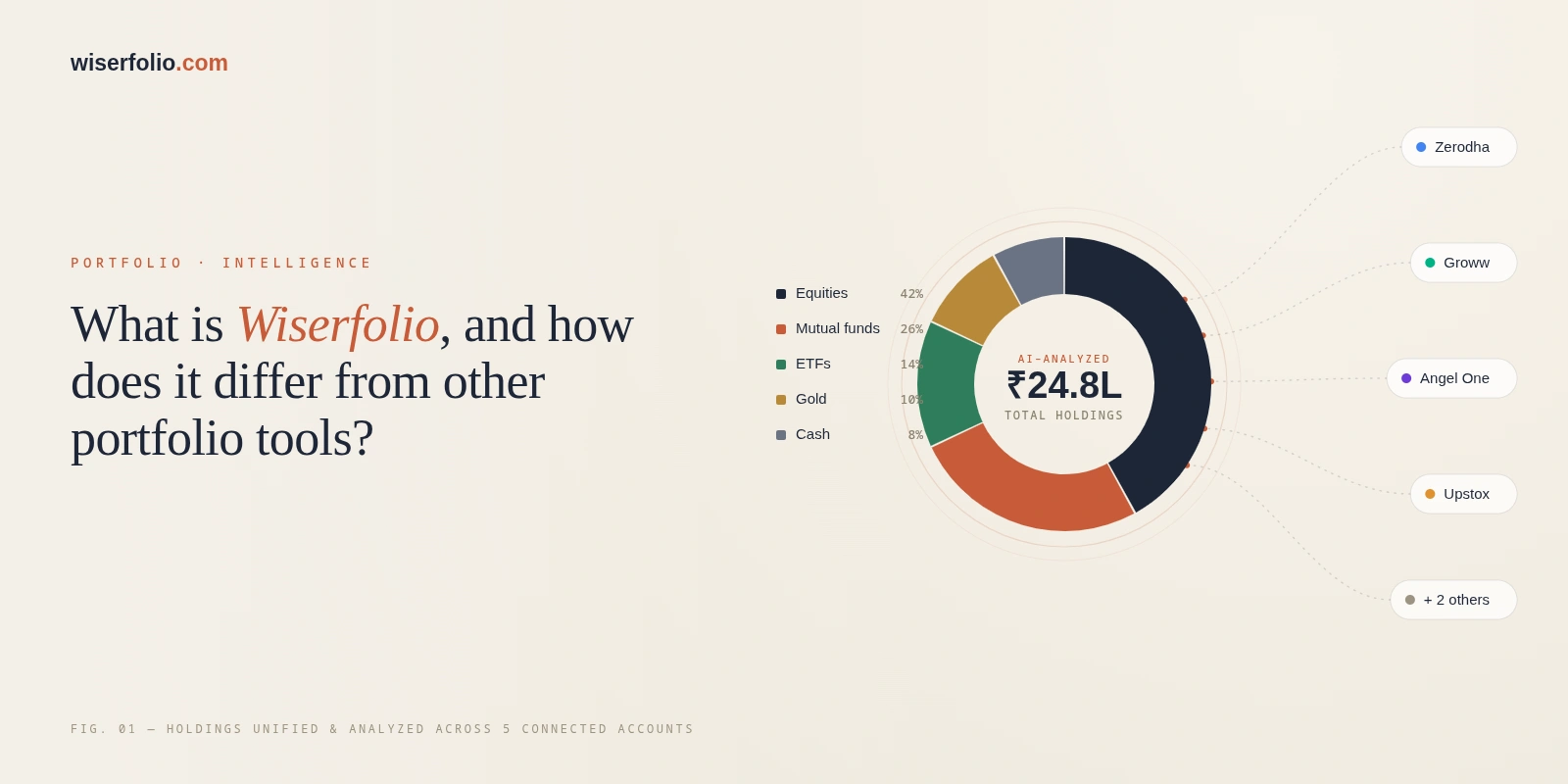
Most portfolio tools were built for people who already speak the language of markets. Wiserfolio was built for everyone else — the salaried investor with a folder of mutual funds and a vague worry that something might be off, who wants a straight answer instead of another dashboard to decode.
If you have invested for a few years through a broker or a fund platform, you have probably accumulated a portfolio without ever stepping back to look at it as a whole. A fund bought on a tip here, a stock that a colleague recommended there, an SIP started and forgotten. Individually each decision made sense. Together, they may add up to something lopsided, expensive, or quietly risky — and nothing in your broker app is designed to tell you so.
Wiserfolio is an attempt to fill that gap. It is a tool that reads your existing holding statement and returns a plain-language analysis of what you actually own, what is wrong with it, and what you might do about it. No account linking, no jargon, no upsell into a product it earns commission on.
What it actually does
The mechanics are deliberately simple. You upload the holding statement you already receive from your broker or depository — the same PDF that lands in your inbox. Wiserfolio reads it, identifies every position, and runs an analysis across the dimensions that tend to matter most for an individual investor: how concentrated you are, whether your funds secretly overlap, what your fee drag looks like, how your money is split across sectors and asset classes, and where the tax-saving opportunities sit.
A few seconds later you get a written report. Not a wall of ratios, but an actual assessment — the kind a thoughtful advisor might give you if you sat across a desk and showed them your statement. It tells you, for instance, that two stocks make up most of your portfolio and what that means if either one stumbles, or that three of your funds hold largely the same companies so your diversification is more apparent than real.
The guiding idea is that the most valuable thing software can give an ordinary investor is not more data — they already drown in it — but a clear, honest interpretation of the data they have.
Where the typical portfolio tool falls short
To understand what Wiserfolio is for, it helps to look at what most existing tools are not built to do. Broadly, the portfolio tools available to Indian investors fall into a few categories, and each leaves the same person underserved.
The first category is the broker dashboard — the screen inside your trading app. It shows you current value and profit-and-loss, and that is roughly where its ambition ends. It will happily display a portfolio that is 70% in one stock without ever suggesting that this might be a problem. It reports; it does not assess.
The second is the screener and research platform. These are powerful, but they are built for analysis of individual securities, not for an honest verdict on your particular mix. They hand you ratios, charts, and filters and assume you know how to assemble them into a conclusion. For someone who already knows what they are doing, they are excellent. For someone who does not, they are an intimidating wall of numbers that produces anxiety rather than clarity.
The third is the advisory service — a human advisor or a managed plan. This is often genuinely useful, but it tends to be expensive, out of reach until your portfolio is large enough to be worth someone's time, and frequently entangled with commissions on the products being recommended. The incentive to tell you something is not always aligned with your interest in hearing the truth.
What sits in the middle — plain, prescriptive, affordable interpretation for the ordinary investor — has historically been thin. That middle is where Wiserfolio aims to live.
What makes the approach different
A few choices set the tool apart from the categories above.
It interprets, rather than just displays. The output is a verdict, not a dashboard. Where a screener shows you that a stock is 60% of your holdings, Wiserfolio tells you what a 60% concentration does to your risk, quantifies the potential damage of a bad day, and lays out how you might reduce it — including the tax consequences of doing so.
It speaks plainly. The entire report is written to be understood by someone with no finance background. Concentration, overlap, fee drag, sector risk — each is explained in terms of what it means for your money, not in the vocabulary of a CFA curriculum.
It engages with your actual goal. If you tell it what you are trying to achieve — a return target, a time horizon, a near-retirement need for safety — the analysis is organised around answering that, honestly, even when the honest answer is that the goal is unrealistic given the portfolio. A tool that simply applauds your plan is less useful than one that tells you the truth about it.
It has no product to sell you. Wiserfolio does not earn commission on funds or stocks, so it has no reason to nudge you toward one. Its only job is to analyse what you already own. That independence is the point.
It respects what it costs. Your first report is free, and you can see a full sample before paying, so you know exactly what you are buying. There is no subscription you forget to cancel — a report is a one-time thing you reach for when you need it.
What it is not
It is worth being equally clear about the limits, because a tool that overclaims is not trustworthy. Wiserfolio is an informational and educational service, not a registered investment adviser. It does not tell you to buy or sell specific stocks, and it is not a substitute for a SEBI-registered adviser or a chartered accountant when your situation calls for one. It analyses the statement you give it; it is a second opinion, a clarity engine, a way to finally see your own portfolio clearly — not a manager that acts on your behalf.
For a great many investors, though, that second opinion is exactly the thing that has been missing. Not more data. Not another login. Just an honest, readable answer to the question that quietly nags at anyone who has been investing for a while: is my money actually set up well, and what should I fix? If you'd like to start answering that yourself, our guide on how to read your portfolio like an analyst is a good place to begin.
See your own portfolio's hidden risks
Upload your statement and Wiserfolio shows your concentration, fund overlap, fees, and tax moves in 90 seconds.
Analyze my portfolio free →